
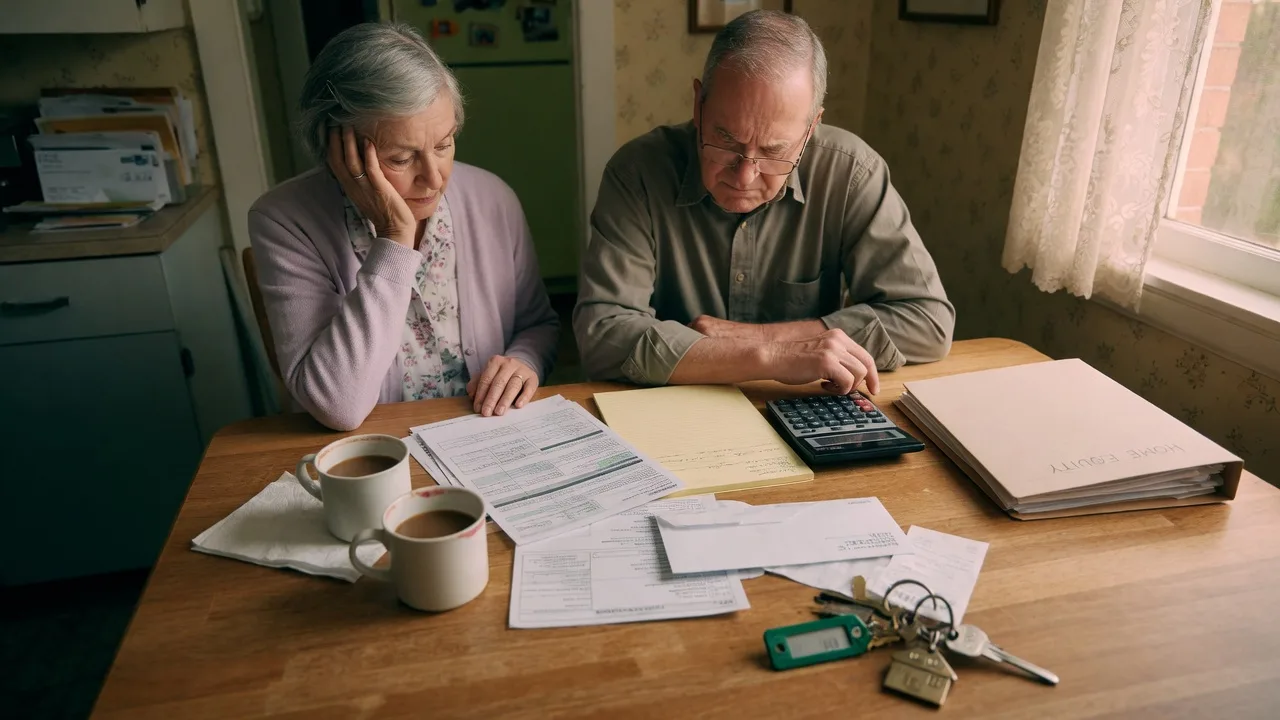
I've sat at a lot of kitchen tables over the past 23 years. And more often than not, the conversation starts the same way: "Vickie, I love this house. It's been our home for 40 years. But I'm not sure we can afford to stay anymore." That's a hard thing to say out loud. The home that raised your kids, hosted every Thanksgiving, and holds every memory you cherish becomes a financial question you didn't ask for. Let's look at the numbers honestly, with empathy, and figure out what makes sense for you.
The hidden costs of staying in your home
When you've lived in a home for decades, the costs blur into the background. The mortgage payment is just something that comes out every month. The property tax bill shows up twice a year. The roof holds, the furnace runs, and you don't think much about it until something breaks. But the real cost of staying is a lot bigger than your monthly payment.
Here are the costs I see seniors carrying year after year, often without realizing how much they add up:
- Mortgage or taxes: Even a paid-off home costs money in property taxes, insurance, and HOA dues. In the Portland metro area, property taxes on a 3-bedroom family home often run $5,000 to $8,000 a year or more.
- Rising maintenance: A 40-year-old roof needs replacing. The furnace is 25 years old and running on borrowed time. The water heater, the driveway, the windows. Deferred maintenance piles up fast. I've seen homes where the needed repairs total $30,000, $50,000, even $80,000.
- Utilities: Heating and cooling a 2,500-square-foot home when you only use three rooms is like running the AC with the windows open. You're paying to condition space you don't use.
- Insurance: Homeowners insurance on a larger, older property costs more, and rates have been climbing across Oregon.
- Healthcare accessibility: This is a big one. If your home has stairs and you develop mobility issues, the cost of a stairlift, bathroom modifications, or even an unexpected fall can be enormous.
- Yard upkeep: Lawn care, tree trimming, gutter cleaning. Either you're doing it yourself well past the age you should be on a ladder, or you're paying someone. That adds up to $150 to $400 a month depending on the property.
And here's the thing nobody talks about: the opportunity cost of the equity sitting in your home. That $400,000 or $500,000 or $700,000 in home equity could be working for you in retirement instead of sitting in a house that's too big for your current needs.
When staying costs more than moving
I've had clients tell me, "I can't afford to move." And I understand that feeling. Moving feels expensive. But I've run the numbers with hundreds of families, and here's what I've found: in many cases, staying in the family home actually costs more than downsizing.
Let's look at where the savings come from when you rightsize:
- Smaller utility bills: A 1,200-square-foot condo or smaller home costs 30 to 50 percent less to heat, cool, and light than a 2,500-square-foot house.
- Less maintenance: No more roof worries, no more replacing a 30-year-old furnace, no more painting the exterior every eight years. An HOA-maintained property handles the exterior for you.
- No more mortgage: Many seniors can use the equity from their sale to buy their next home outright. That means no monthly mortgage payment, period.
- Lower taxes: A smaller home typically means lower property taxes, especially if you move to a home in a more affordable price range or jurisdiction.
- Lower insurance: Smaller home, lower replacement cost, lower premium.
- One-level living: No stairlift needed, no bathroom remodel for accessibility, no risk of falling on the stairs.
The emotional cost vs. the financial cost
Let me be direct with you: the emotional cost of leaving a family home is real, and I will never minimize that. When you've raised children in a house, celebrated holidays, marked heights on the doorframe, and built a life within those walls, walking away feels like a loss. It is a loss.
But here's what I've learned from 23 years of helping families through this: the emotional attachment is to the memories, not the building. The memories go with you. What stays behind is the roof, the walls, and the bills.
When I work with a family, I give them permission to feel both things at once: the grief of leaving and the relief of making a smart decision. Those two feelings can coexist. You can honor what the home has meant to you and still make a clear-eyed financial choice that protects your future.
I've seen clients who put off the decision for years, spending their retirement savings on maintaining a house they barely used. And I've seen clients who made the move, felt the sadness for a season, and then told me six months later, "Why didn't we do this sooner?" The weight they were carrying, the worry about the stairs, the stress of the yard, the fear of what would break next, it all lifted.
A real-world comparison: staying vs. downsizing
Let me give you a typical example from my work in the west side of Portland. These are real numbers, anonymized, from actual clients:
The Smiths (not their real name) owned a 2,800-square-foot home in Beaverton built in 1985. They were both retired, on fixed income, and the house was paid off. Here's what they were spending each month to stay:
- Property taxes: $580
- Homeowners insurance: $145
- Utilities (gas, electric, water, trash): $390
- Yard maintenance: $200
- Maintenance reserve (roof, furnace, etc. amortized): $350
- Total staying: $1,665 per month
They sold their home for $625,000, netted about $600,000 after costs, and bought a 1,300-square-foot single-level condo in Tigard for $425,000. Their new monthly costs:
- HOA dues (covers exterior, landscaping, common areas): $350
- Property taxes: $320
- Homeowners insurance: $80
- Utilities: $195
- No mortgage (paid cash with equity) and no yard maintenance
- Maintenance reserve: $100
- Total downsized: $1,045 per month
That's a savings of $620 per month, or $7,440 per year. Plus, they banked $175,000 in cash from the sale, giving them a real financial cushion for retirement. No more worrying about the roof, no more Saturday mornings mowing, no more stair-climbing with groceries.
Every situation is different. Yours might show an even bigger gap, or a smaller one. The point is to run the numbers so you can see the picture clearly.
When downsizing makes the most financial sense
In my experience, certain life events trigger the moment when the math shifts from "maybe someday" to "right now." Here are the most common ones I see:
- Retirement and fixed income: When your income drops from a salary to Social Security and retirement accounts, every dollar counts. A $1,600 monthly housing cost on a fixed income feels very different than it did when you were working.
- A fall or health change: One trip to the emergency room can change everything. A home you've managed for decades suddenly feels dangerous. The cost of modifying the home for accessibility (stairlifts, roll-in showers, ramps) can run $10,000 to $50,000.
- Unexpected repair costs: That $15,000 roof replacement or $8,000 HVAC system can be the straw that breaks the camel's back. When a major repair hits and you're on a fixed income, it forces the question.
- The last child leaves: When you're rattling around in a four-bedroom house by yourself, it's hard to justify the cost and the upkeep.
- The death of a spouse: This is one of the hardest situations I see. Not only is the emotional loss devastating, but the household income often drops while the housing costs stay the same.
- Inheriting a property: If you inherit a family home and already have your own, you now have two properties to maintain, insure, and pay taxes on.
If any of these sound familiar, it might be time to run the numbers on what staying is really costing you.
Get your free housing cost worksheet
I've put together a Housing Cost Worksheet For Seniors that walks you through every expense I've listed above. You fill in your own numbers, add them up, and see clearly what you're spending each month to stay. Then you can compare that with what you'd likely spend in a smaller home, condo, or retirement community.
The PDF download is ready below. Just fill in your information and you'll get immediate access to the Housing Cost Worksheet For Seniors.
Download includes: The Housing Cost Worksheet For Seniors with categories for mortgage/taxes, insurance, utilities, maintenance, yard care, HOA, healthcare access costs, and a comparison calculator to see the difference between staying and downsizing.
Resources and next steps
Here's what I recommend if you're weighing this decision:
1. Download the Housing Cost Worksheet. Fill it out with your actual expenses. Don't guess. Look at your bank statements and tax bills. The truth is in the numbers.
2. Talk to someone who's been through it. If you know a friend or family member who downsized, ask them what it really cost and what surprised them. Most people tell me the relief was bigger than they expected.
3. Get a market assessment. Know what your home is worth in today's market. The number might surprise you, and it's a critical piece of the equation.
4. Talk to a tax professional. A CPA or financial advisor can help you understand the tax implications of selling, including capital gains exemptions on your primary residence.
5. Call me. I've been doing this for 23 years. I've helped hundreds of families on the west side of Portland make this decision. I'll listen to your situation, give you my honest assessment, and connect you with the professionals you need. No pressure, no sales pitch. Just experienced, empathetic advice.
Ready to plan your next move?
I specialize in helping seniors and their families navigate downsizing with honesty, empathy, and 23 years of experience. Let's talk about your situation.